OPES INITIATIVE
Optimal Procedures for EEG Standards (OPES) Initiative
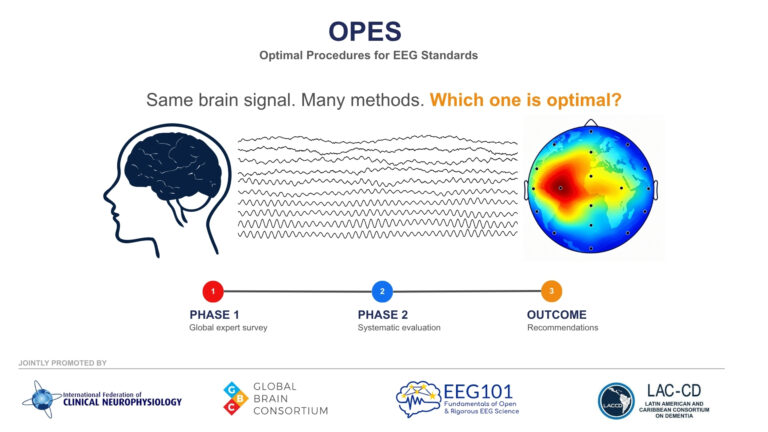
Advancing International Standards for Quantitative EEG Analysis
Electroencephalography (EEG) is widely used to study brain function in both research and clinical practice. However, differences in how EEG data are processed and analyzed can make it difficult to compare findings across laboratories, recording systems, and populations.
The Optimal Procedures for EEG Standards (OPES) initiative is an international collaborative effort to develop consensus-based recommendations for quantitative EEG (qEEG) analysis. By bringing together EEG experts from around the world, OPES aims to identify best practices that will improve the reproducibility, consistency, and clinical application of EEG findings.
About the Initiative
OPES brings together researchers and clinical neurophysiologists to evaluate existing EEG analysis methods and establish internationally recognized standards.
The initiative will gather expert input on commonly used methodologies, systematically compare different approaches, and develop practical recommendations for EEG preprocessing and analysis.
The ultimate goal is to create a transparent, evidence-based framework that can be used by researchers and clinicians worldwide.
Project Objectives
The OPES initiative focuses on several important aspects of EEG preprocessing and analysis:
Automated artifact detection and channel rejection
EEG re-referencing strategies
Separation of periodic and aperiodic components of power spectra
Estimation of cortical source activity and functional connectivity
Harmonization across electrode montages and recording systems
Through this work, OPES aims to develop consensus-driven recommendations, a common terminology for qEEG analysis, and resources that support reproducibility and collaboration across institutions.
Project Phases
Phase 1: International Expert Survey
The first phase of OPES invites EEG experts worldwide to participate in an online survey about current practices in EEG analysis.
Participants are asked to identify the methods they currently use and those they consider most appropriate for different stages of qEEG analysis.
The results will help identify commonly used approaches, areas of agreement, and topics requiring further evaluation.
Phase 2: Systematic Evaluation of EEG Methods
The second phase will involve a systematic comparison of widely used EEG preprocessing and analysis methods using a high-quality reference database of resting-state, eyes-closed EEG recordings from healthy adults, balanced for age and sex.
This evaluation will help determine which approaches offer the greatest reliability, reproducibility, and consistency across different recording conditions.
Phase 3: International Consensus and Recommendations
Building on the survey findings and methodological evaluations, OPES will bring together international experts to develop consensus-based recommendations for qEEG analysis.
An international consensus meeting is planned for Rome, Italy, in 2027.
The initiative also aims to develop a common qEEG terminology, an accompanying ontology, and an open-access EEG database to support future research and clinical applications.
Participate in the OPES Survey
EEG Experts Worldwide Are Invited to Participate
Your expertise can help shape the future of quantitative EEG standards.
If you work with EEG data in research or clinical practice, we encourage you to complete the OPES survey and share it with colleagues who may be interested in contributing.
Collaborating Organizations
OPES is jointly promoted by four international organizations:
International Federation of Clinical Neurophysiology (IFCN) – Advanced EEG-MEG Techniques in Clinical Neurophysiology Special Interest Group
European COST Action EEG101
Latin American and Caribbean Consortium on Dementia (LAC-CD)
Global Brain Consortium
Together, these organizations are supporting international collaboration to advance EEG standards and promote the broader application of quantitative EEG in research and clinical neurophysiology.
IFCN Strategic Fund Support
In September 2026, the OPES initiative received a USD 10,000 award from the IFCN Strategic Fund.
This funding will support the international expert consensus meeting planned for Rome in 2027, along with ongoing efforts to develop common qEEG terminology and an open-access EEG database.
The IFCN Strategic Fund supports initiatives that advance clinical neurophysiology through international collaboration, education, research, and scientific development.